China Heart-Healthy Diet for Hypertension

Updated: Aug 31
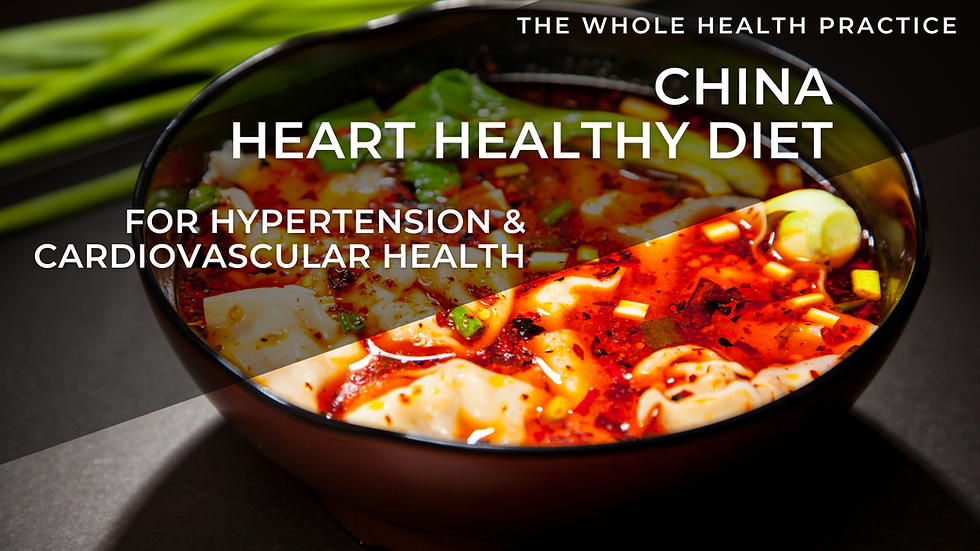
Scientists from the US’ National Institutes of Health developed the ‘DASH’ diet to reduce high blood pressure. Low in salt, rich in vegetables, whole grains and legumes, the DASH diet has been easy for people to implement at home and has delivered positive health results. What happened when scientists in China tailored the DASH diet to suit local tastes in a randomized controlled trial across four cities? The success of the diet in lowering hypertension was repeated. This provides useful lessons, not in only dietary modification and public health in China but also for countries in the region.
Chinese researchers created a relatively low salt, low fat and high fibre diet to see the outcome on heart and vascular health. The intervention reduced sodium from 6000mg to 3000mg per day (this is still above the WHO recommendation of 2000mg per day), increased potassium and doubled the daily fibre intake by increasing vegetable, legume and fruit intake. Not surprisingly the results showed great improvements for those in the intervention group. For those on the heart healthy diet, compared to the control group eating normal cuisine) blood pressure lowered by an average 10 mm Hg and diastolic blood pressure fell by an average 3.8 mm Hg. This is the equivalent of taking blood pressure medicine with none of the side effects or costs.
The China Heart Healthy Diet used four regional cuisines - Cantonese, Huaiyang, Shangdong and Sichuan – mirroring the four population centres where the trial was conducted. The China Heart Healthy Diet reflected local tastes and was effective in its focus on local and traditional ingredients only marginally more expensive than food used for the control groups. This provides a useful case study for countries that have undergone or are going through the nutrition transition from traditional food culture to diets higher in processed foods and animal products. Specifically for China we can compare data from 1982 and 2012 showing that consumption of grain foods, tubers and legumes, vegetables and fruits decreased by 34%, 80%, and 15%, respectively. Meanwhile meat, eggs, and edible oil consumption increased by 162%, 233% and 132% respectively.

How does this relate, say, outside of China? Says Felicia, The Whole Health Practice's co-founder and nutritionist, “Cutting back on salt, using low sodium soy sauce or salt substitutes directly addresses the quantity of salt in the diet.” But what about flavour? She recommends that we "Enjoy local foods based on traditional cuisines. These are likely in keeping with flavours than you can relate to and enjoy. For example, Southeast Asia has a vast variety of kampung (village) cuisines that can be enjoyed. Focus on simple daily foods rather than the richer specialities that used to be consumed only on feast days."
We reached out to Singaporean foodie and food technologist Andrew Yip, who spent his early years in the kitchen and more recently in a food laboratory. He advises to “Let salt play its functional role, use enough to bring out the natural flavours of the other ingredients.”
He parallels Felicia’s advice to concentrate on flavour, suggesting “to include black or white pepper 黑/白 - 胡椒 , for enhancing the flavour of dishes use combinations of spices to generate natural sweetness and umaminess of dishes: amomum tsaoko 草果, bay leaf 月桂葉/香葉, chenpi 陳皮, cinnamon 肉桂/ 桂皮, liquorice root 甘草”. For meat dishes Andrew recommends “Sand ginger 沙薑, sichuan pepper 花椒, star anise 八角/ 大料 and cloves 丁香 are great to provide aroma and taste to dishes. Try using ingredients like garlic, onions, radish and carrots and corn for sweetness and balance with dash of mirin and rice vinegar.”
Final Thoughts
Wherever you reside, minimise your consumption of processed or preserved foods (often high in salt and refined carbohydrates), enjoy plant-rich dishes and moderate the consumption of meat. Making these small changes in eating practices can provide massive long-term benefits in terms of your health and quality of life.
Supporting your body through balanced nutrition, physical activity, stress reduction, quality sleep and meaningful social connection (these are known as the Pillars of Health) are some of the most powerful health 'tools' we have. Changing health for the better is about consistent progress, not perfection, and even small changes can make a meaningful difference over time.
As always, the best health strategy is one you can stick with - one that fits your personal lifestyle profile. Improving health is about finding motivation, prioritising self-care and taking action. If you want to take effective and targeted steps to that fit into your unique lifestyle, The Whole Health Practice is here to help. Whether you want to improve eating practices, beat chronic illness or enhance your overall well-being, our consultations and programs deliver results that are tailored to your needs.

FOUNDATIONS - our premier whole person health consult - identifies and prioritises the key factors, known and unknown, that affect health and wellbeing. It provides targeted recommendations tailored to you, the individual, and your unique lifestyle.
Stay Healthy,
Alastair
Join us, or scroll down to contact us and learn more about our services:

Achieve your Health Goals
Our health, physical – mental – social - is complex and affected by multiple factors within and outside of your control. Our consults and programmes address the whole person, the root causes of ill health and maximising your health, performance & vitality.
Take the first step. Contact us to arrange an introductory call, to discuss how we can support your journey to health. We are based in Singapore and work with clients globally.
Want to put recommendations into action? Learn more about our programmes for individuals or teams.
Related Studies
The study in question: Wang Y, Feng L, Zeng G, Zhu H, Sun J, Gao P, Yuan J, Lan X, Li S, Zhao Y, Chen X, Dong H, Chen S, Li Z, Zhu Y, Li M, Li X, Yang Z, Li H, Fang H, Xie G, Lin PH, Chen J, Wu Y; DECIDE-Diet Study Group. Effects of Cuisine-Based Chinese Heart-Healthy Diet in Lowering Blood Pressure Among Adults in China: Multicenter, Single-Blind, Randomized, Parallel Controlled Feeding Trial. Circulation. 2022 Jul 26;146(4):303-315. doi: 10.1161/CIRCULATIONAHA.122.059045. Epub 2022 Jul 11. PMID: 35861850; PMCID: PMC9311470.
Others...
Xin Y, Shui D, Yan G, Tian W, Tang N, Liang J, Peng J, Sun H, Ge A, Liu X, Kissock K, Trieu K, Zhang J, Zhang X, Ye P, Tian M. Dietary Risk Factors and Associated Disease Burden Among Chinese Adults Aged 25 Years and Older: Systematic Analysis of the Global Burden of Disease Study 2021. JMIR Public Health Surveill. 2025 Aug 25;11:e72978. doi: 10.2196/72978. PMID: 40934441; PMCID: PMC12441878.
Cai J, Sun X, Li M, Luo R, Wang W, Wang Z, Akkaif MA, Liu H. Dietary factors in relation to hypertension: a mendelian randomization study. J Health Popul Nutr. 2024 Jun 21;43(1):91. doi: 10.1186/s41043-024-00575-7. PMID: 38907314; PMCID: PMC11193250.
Li Q, Feng L, Sun J, Zhu H, Zeng G, Gao P, Yuan J, Zhao Y, Li S, Lan X, Chen X, Li Z, Chen S, Dong H, Li M, Li X, Yang Z, Li H, Xie G, Wang Z, Lin PH, Chen J, Wang Y, Wu Y; DECIDE-Diet Study Group includes the following; Study Management Committee; Study Advisory Committee; Participating centers and staff information. Effects of Chinese heart-healthy diet on blood lipids, glucose, and estimated 10-y cardiovascular disease risk among Chinese adults: results on secondary outcomes of a randomized controlled trial. Am J Clin Nutr. 2024 Feb;119(2):333-343. doi: 10.1016/j.ajcnut.2023.12.008. Epub 2023 Dec 16. PMID: 38110039.
Cai, J., Sun, X., Li, M. et al. Dietary factors in relation to hypertension: a mendelian randomization study. J Health Popul Nutr 43, 91 (2024). https://doi.org/10.1186/s41043-024-00575-7
Theodoridis X, Chourdakis M, Chrysoula L, Chroni V, Tirodimos I, Dipla K, Gkaliagkousi E, Triantafyllou A. Adherence to the DASH Diet and Risk of Hypertension: A Systematic Review and Meta-Analysis. Nutrients. 2023 Jul 24;15(14):3261. doi: 10.3390/nu15143261. PMID: 37513679; PMCID: PMC10383418.
Yin R, Yin L, Li L, Silva-Nash J, Tan J, Pan Z, Zeng J, Yan LL. Hypertension in China: burdens, guidelines and policy responses: a state-of-the-art review. J Hum Hypertens. 2022 Feb;36(2):126-134. doi: 10.1038/s41371-021-00570-z. Epub 2021 Jul 2. PMID: 34215840; PMCID: PMC8252986.
Aliasgharzadeh S, Tabrizi JS, Nikniaz L, Ebrahimi-Mameghani M, Lotfi Yagin N. Effect of salt reduction interventions in lowering blood pressure: A comprehensive systematic review and meta-analysis of controlled clinical trials. PLoS One. 2022 Dec 7;17(12):e0277929. doi: 10.1371/journal.pone.0277929. PMID: 36477548; PMCID: PMC9728935.
Filippou CD, Tsioufis CP, Thomopoulos CG, Mihas CC, Dimitriadis KS, Sotiropoulou LI, Chrysochoou CA, Nihoyannopoulos PI, Tousoulis DM. Dietary Approaches to Stop Hypertension (DASH) Diet and Blood Pressure Reduction in Adults with and without Hypertension: A Systematic Review and Meta-Analysis of Randomized Controlled Trials. Adv Nutr. 2020 Sep 1;11(5):1150-1160. doi: 10.1093/advances/nmaa041. PMID: 32330233; PMCID: PMC7490167.
Bai G, Zhang J, Zhao C, Wang Y, Qi Y, Zhang B. Adherence to a healthy lifestyle and a DASH-style diet and risk of hypertension in Chinese individuals. Hypertens Res. 2017 Feb;40(2):196-202. doi: 10.1038/hr.2016.119. Epub 2016 Sep 8. PMID: 27604345.


Comments