Electrolytes for Exercise? Convenience and Price in a Packet


Beyond an hour of exercise in the heat, electrolytes become a sensible option. They suit heavy sweaters, people finishing with salt-crusted kit, and anyone out for a longer session. If this makes sense (or not) for the athlete or especially the non-athlete, we discussed in another article.
In the scenario that we do want to use electrolytes - here we dive a little deeper into the products themselves, what are we being asked to pay for? We review a premium electrolyte mix - targeted at 'tropical' runners - and compare it with a 'budget' option.
As ever, please talk to your doctor or medical practitioner most familiar with your medical history before implementing any changes in diet, exercise or lifestyle, especially if you are under treatment. Links to studies / resources at bottom of page.
Sachet or kitchen mix?
To use electrolytes, there are three broad routes to follow: to buy a commercial beverage, use a flavoured sachet such as Humantra Tropical, or make a home version with salt.
Why have we chosen Humantra Tropical? It is currently well advertised on my social media feeds. And for our slat choice: Pagoda 'Less Sodium Natural Mineral Salt'. Why? It has a very similar mineral composition to Humantra.
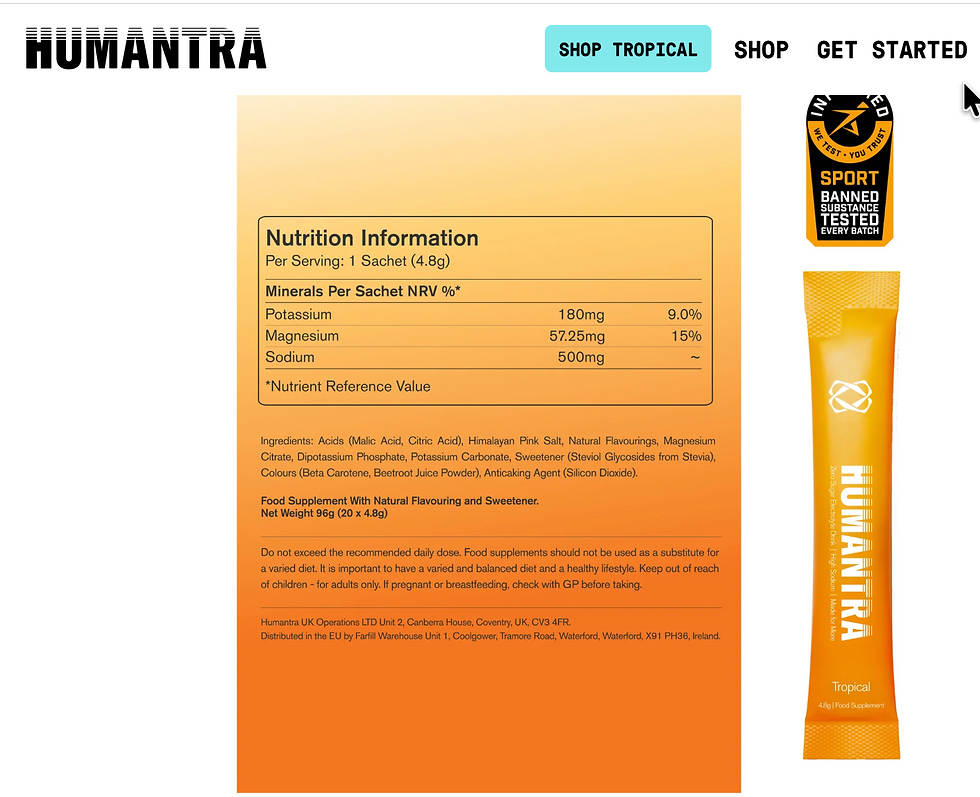
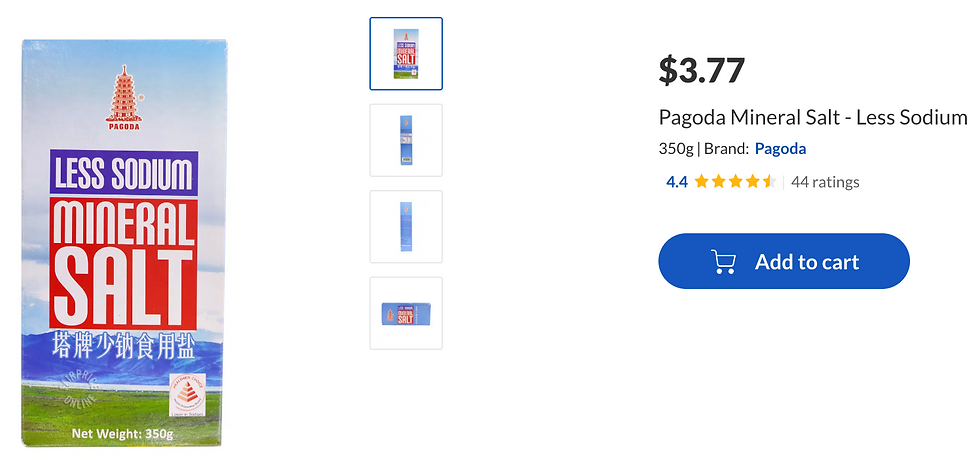
The two products are far more alike than the marketing, packaging or price suggests.
Humantra Tropical (1 sachet, 4.8g) | Pagoda Salt (about 2.1g) | |
Sodium | 500mg | 500mg |
Potassium | 180mg | about 195mg |
Magnesium | 57mg | about 7mg |
Chloride (estimated) | about 750 to 770mg | about 950mg |
Sugar | none | none |
Flavour | acids, natural flavour, stevia | none |
Humantra's sodium comes from Himalayan pink salt - sodium chloride, and Pagoda is plain sodium chloride too. Where they part ways is the supporting cast.
Humantra supplies potassium as dipotassium phosphate and potassium carbonate, magnesium as magnesium citrate, and then adds malic and citric acid, natural flavouring, stevia, and colours from beta carotene and beetroot.
Pagoda uses potassium chloride, a little magnesium sulphate, calcium carbonate, and an anti-caking agent (silicon dioxide) which Humantra also uses.
Neither contains sugar, so neither fuels you. If you're out for hours, your carbohydrates need to come from somewhere else.
The practical similarities and differences are these:
Sodium and potassium: a near match, so the home mix is no weaker where it counts.
Chloride: it isn't on either label. My estimate from the listed minerals is that Pagoda gives about a quarter more, because its potassium is also chloride-based. Treat both numbers as estimates.
Magnesium: the real gap. Humantra gives about eight times as much, and it's in a well-absorbed citrate form. Sweat losses of magnesium are small next to sodium.
Taste: Potassium chloride is bitter and metallic, and plain Pagoda in water is harsher than a flavoured product. A splash of your favourite fruit cordial will take care of it - the sugars also support the hydration process and energy balance.
Testing: Humantra carries an Informed Sport batch-testing badge. That matters if you compete in tested events, and unlikely an issue for a home mix.
Cost
Humantra is S$2.00 per sachet.
Pagoda is S$3.77 for 350g, so roughly 2 cents ($0.02) to match Humantra's basic electrolyte mix. The price difference? You're paying for flavour, magnesium, convenience and the testing badge.
That makes Humantra around 90 times more expensive for the same sodium, chloride and potassium.
A three hour exercise session, a long ruck, might cost you S$6 to S$8 with the Humantra, versus a few cents.
Final Thoughts
In either product the salt is the same salt. In fairness, the supermarket salt will require the addition of a few cents worth of juice or fruit cordial into one's hydration bladder.
For most people, most of the time, a home mix does the electrolyte job for pennies, and the only thing you give up is magnesium, which you probably don't need need mid-session anyway. If I want to make up the magnesium, a tablespoonful of pumpkin seeds (10 to 12g) or a couple of squares of dark chocolate will make up the balance. And provide additional nutrients as well.
A sachet earns its place when convenience wins: carried in a race pack, a long day out with no kitchen. Neither product changes the basic rule: below an hour, water is enough, and above it, electrolytes are an option rather than an obligation. What source of electrolytes? That is up to you!
The best health strategy is one you can stick with. Whether you want to beat chronic illness or improve your well-being and performance, The Whole Health Practice helps you take targeted action that fits your unique lifestyle. Explore our consultations and programs and take control of your health.

FOUNDATIONS - our premier whole person health consult - identifies and prioritises the key factors, known and unknown, that affect health and wellbeing. It provides targeted recommendations tailored to you, the individual, and your unique lifestyle.
Stay Healthy,
Alastair
Join us, or scroll down to contact us and learn more about our services:

Achieve your Exercise and Health Goals
Your health, physical – mental – social - is complex and affected by multiple factors within and outside of your control. Our consults and programmes address the whole person, the root causes of ill health and maximising your health, performance & vitality.
Take the first step. Contact us to arrange an introductory call, to discuss how we can support your journey to health. We are based in Singapore and work with clients globally.
Book a Whole Health Consult to assess, identify and prioritise key factors (known and unknown) that affect your health. And receive personalised recommendations on how to address them.
Want to put recommendations into action? Learn more about our programmes for individuals or teams.
Related Studies
Killick JA, Jenkins EJ, Benson J, Macciochi J, Corr L. Comparing the Effects of Water, Sodium-Potassium, and Potassium-Rich Solutions on Fluid Balance and Thermal Strain Following Exercise in the Heat: A Randomized Triple-Blind Crossover Study. Int J Sport Nutr Exerc Metab. 2026 Aug 13:1-9. doi: 10.1123/ijsnem.2026-0016. Epub ahead of print. PMID: 42601056.
McCubbin AJ, da Costa RJS. Effect of Personalized Sodium Replacement on Fluid and Sodium Balance and Thermophysiological Strain During and After Ultraendurance Running in the Heat. Int J Sports Physiol Perform. 2023 Nov 9;19(2):105-115. doi: 10.1123/ijspp.2023-0295. PMID: 37944507.
Veniamakis E, Kaplanis G, Voulgaris P, Nikolaidis PT. Effects of Sodium Intake on Health and Performance in Endurance and Ultra-Endurance Sports. Int J Environ Res Public Health. 2022 Mar 19;19(6):3651. doi: 10.3390/ijerph19063651. PMID: 35329337; PMCID: PMC8955583.
Surapongchai J, Saengsirisuwan V, Rollo I, Randell RK, Nithitsuttibuta K, Sainiyom P, Leow CHW, Lee JKW. Hydration Status, Fluid Intake, Sweat Rate, and Sweat Sodium Concentration in Recreational Tropical Native Runners. Nutrients. 2021 Apr 20;13(4):1374. doi: 10.3390/nu13041374. PMID: 33923890; PMCID: PMC8072971.
Turner MJ, Avolio AP. Does Replacing Sodium Excreted in Sweat Attenuate the Health Benefits of Physical Activity? Int J Sport Nutr Exerc Metab. 2016 Aug;26(4):377-89. doi: 10.1123/ijsnem.2015-0233. Epub 2016 Feb 3. PMID: 26841436.
Other
Jiménez-Alfageme R, Garrone FP, Rodriguez-Sanchez N, Romero-García D, Sospedra I, Giménez-Monzó D, Ayala-Guzmán CI, Martínez-Sanz JM. Nutritional Intake and Timing of Marathon Runners: Influence of Athlete's Characteristics and Fueling Practices on Finishing Time. Sports Med Open. 2025 Mar 16;11(1):26. doi: 10.1186/s40798-024-00801-w. PMID: 40089940; PMCID: PMC11911277.


Comments