Waist-to-Height Ratio and Physical Performance in Active Adults


Researchers studied over 2,150 active-duty US Marines to test whether a simple measurement, waist-to-height ratio (WHtR), could predict body fat and physical performance better than the military's current tools: body mass index (BMI) and a circumference-based "tape test." WHtR is calculated by dividing waist circumference by height, meaning no complex equations or sex-specific formulas are needed.
The team compared WHtR against DEXA scans (the gold standard for measuring body fat) and against scores on official fitness tests, including running, pull-ups, and core exercises. WHtR tracked closely with DEXA-measured body fat in both men and women. More strikingly, when researchers plotted WHtR against fitness scores, they found a clear inflection point.
As ever, please talk to your doctor or medical practitioner most familiar with your medical history before implementing any changes in diet, exercise or lifestyle, especially if you are under treatment. Links to all studies at bottom of page.
The findings
Performance stayed fairly stable at lower WHtR values, then began dropping once WHtR crossed roughly 0.48 to 0.50. This decline was strongest in tasks requiring people to move their own body weight, like running and pull-ups, but barely showed up in isolated exercises like crunches. That pattern makes physiological sense: carrying extra central mass is a direct handicap when you're hauling your whole body against gravity or across distance, but far less relevant when a muscle group is working in isolation.
This 0.50 threshold wasn't just a performance cutoff. It matched almost exactly with the WHtR level already established in civilian research as an early warning sign for cardiometabolic disease risk. The authors also noted that elite performers in this same population averaged a WHtR around 0.45, reinforcing that 0.50 represents a real, meaningful shift away from a healthy baseline rather than an arbitrary line.
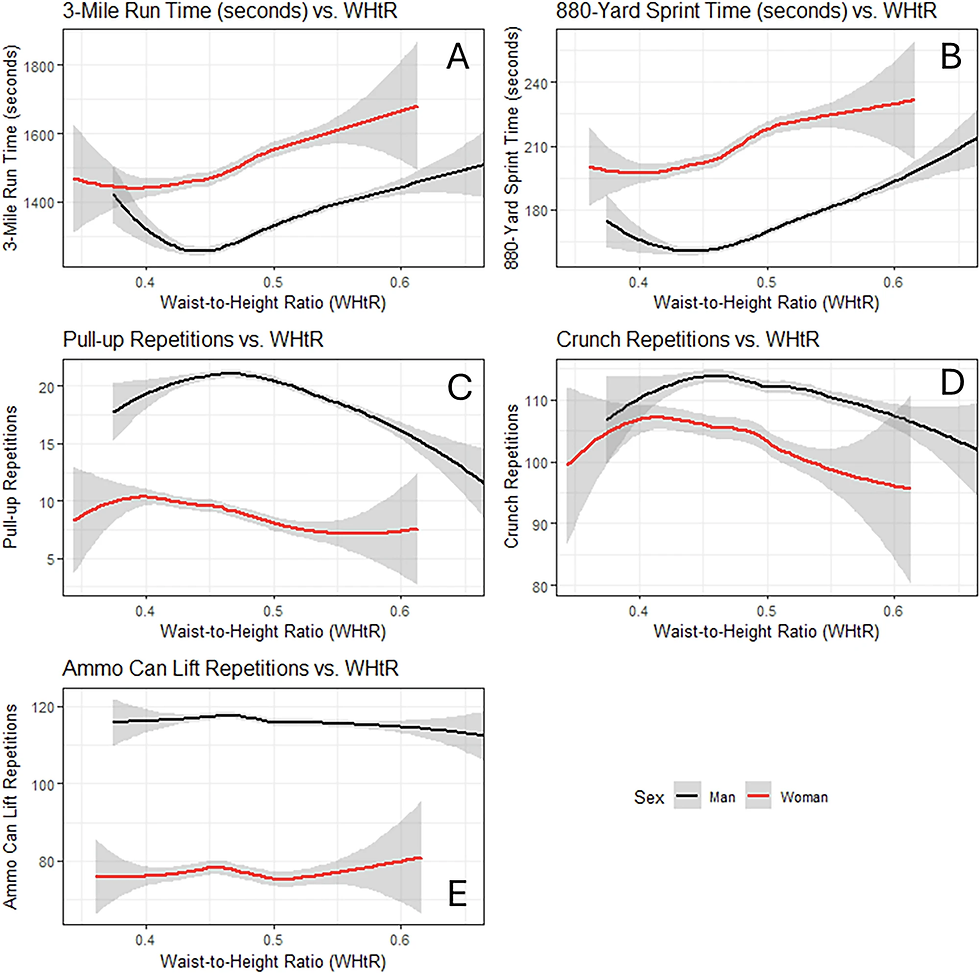
In the image above, sex-specific LOESS curves show that as WHtR increases, performance worsens for the 3-mile run (A) and 880-yard sprint (B), and pull-up repetitions decrease (C). Conversely, performance remains flat for crunches (D) and shows no correlation for ammo can lifts (E). Black lines represent men; red lines represent women.
The study also found that risk isn't a single cliff edge but a rising scale. A WHtR of 0.50 marks the point where risk starts to climb, but values between 0.52 and 0.53 are considered a stronger warning sign, closely linked to metabolic syndrome and insulin resistance. Once WHtR reaches 0.55 or higher, the association with health risk becomes even more pronounced. So the higher above 0.50 someone sits, the more seriously the number should be taken.
On where exactly to measure, the researchers tested three common waist landmarks (at the navel, at the narrowest point of the torso, and at the top of the hip bones) and found the navel measurement tracked most consistently with body fat and performance outcomes. For anyone tracking their own WHtR at home, measuring at the belly button height, rather than sucking in at the narrowest point, gives the most meaningful number.
The researchers were careful to note WHtR isn't a precise body fat measurement, it's a screening flag. The tape test remained more accurate for estimating actual body fat percentage, but it requires more measurements and sex-specific formulas. WHtR's advantage is that it's fast, requires no equations, and still catches most of the same at-risk individuals, making it a practical first-pass check before a more detailed follow-up like bioelectrical impedance analysis.
The authors also pointed out that these findings likely extend well beyond military populations. Firefighters, police tactical units, and endurance or load-carrying athletes would plausibly show the same pattern, since the mechanism (extra central mass as a direct load penalty in weight-bearing, distance-based effort) isn't unique to Marines.
Final Thoughts
You don't need a DEXA scan or a tape measure chart to get a useful read on how your body composition might be affecting your load-bearing capacity. A single ratio, your waist circumference measured at navel height divided by your height, gives a reasonable early signal.
If that number creeps toward or past 0.50, it lines up with both declining physical performance and with broader cardiometabolic risk.
Numbers climbing past 0.52 to 0.53 deserve closer attention, and anything at or above 0.55 is a stronger signal still.
It's not a diagnosis, but it's a useful, no-equipment checkpoint worth tracking alongside your training, particularly if your rucking pace or endurance has been drifting in the wrong direction.
Improving health is about finding motivation, prioritising self-care and taking action. If you want to take effective and targeted steps that fit into your unique lifestyle, The Whole Health If your interest is weight loss, healthspan and longevity, to beat chronic illness or to enhance your mental health and wellbeing, our consultations and programs deliver results that are customised to your needs.

FOUNDATIONS - our premier whole person health consult - identifies and prioritises the key factors, known and unknown, that affect health and wellbeing. It provides targeted recommendations tailored to you, the individual, and your unique lifestyle.
Stay Healthy,
Alastair

Achieve your Health Goals
Your health, physical – mental – social - is complex and affected by multiple factors within and outside of your control. Our consults and programmes address the whole person, the root causes of ill health and maximising your health, performance & vitality.
Contact us to arrange an introductory call, to discuss how we can support your journey to health. We are based in Singapore and work with clients globally.
Consider a FOUNDATIONS Consult to assess, identify and prioritise key factors (known and unknown) that affect your health. And receive personalised recommendations on how to address them.
Want to put recommendations into action? Learn more about our programmes for individuals or teams.
Related Studies and Resources
Potter, A.W., Christopoulos, C.L., Cialdella-Kam, L. et al. A waist-to-height ratio of 0.50 marks declining physical performance in active adults. Eur J Clin Nutr (2026). https://doi.org/10.1038/s41430-026-01798-z
Abdi Dezfouli R, Mohammadian Khonsari N, Hosseinpour A, Asadi S, Ejtahed HS, Qorbani M. Waist to height ratio as a simple tool for predicting mortality: a systematic review and meta-analysis. Int J Obes (Lond). 2023 Dec;47(12):1286-1301. doi: 10.1038/s41366-023-01388-0. Epub 2023 Sep 28. PMID: 37770574.
Jayedi A, Soltani S, Zargar MS, Khan TA, Shab-Bidar S. Central fatness and risk of all cause mortality: systematic review and dose-response meta-analysis of 72 prospective cohort studies. BMJ. 2020 Sep 23;370:m3324. doi: 10.1136/bmj.m3324. PMID: 32967840; PMCID: PMC7509947.


Comments